


Both GPS and offline maps are essential for backpacking because they work together to keep you safe and on the right path. While GPS tells you exactly where you are standing, a map shows you what is around you so you can make smart choices. Many people think they only need one of these tools, but using them together is the best way to avoid getting lost.
When you go into the wild for several days, your phone is often not enough. Phones lose their signals very quickly in deep forests or between high mountains. They also have batteries that die fast when you use the screen for a long time.
A professional outdoor watch is designed to handle these problems. It stays on your wrist and works even when there is no cell service. This guide will help you understand why these features are so important for your next adventure.
The Navigation Debate: GPS Tracking vs. Visual Mapping
GPS tracking and visual mapping solve two very different problems for a hiker. GPS is a system that uses satellites to find your location on the earth. It gives you a specific point in space.
This point is often shown as a small blue dot or a set of numbers called coordinates. It is great for knowing your exact spot, but it does not show you if there is a river or a cliff ten feet away from you.
Visual mapping is the tool that puts your location into a picture. It shows the shape of the land and the location of trails. A map helps you understand the world around your GPS dot. If you only have GPS, you know where you are but you do not know where to go next. If you only have a map, you know what the land looks like but you might not know which part of the map you are standing on.
Experienced hikers know that these two tools must work as a team. The GPS finds the dot, and the map gives that dot a home. This is why the best watches for backpacking always include both features. They allow you to see your path and your surroundings at the same time.
Why Precise GPS is the Backbone of Your Outdoor Watch for Backpacking
A reliable GPS signal is the most important foundation for any outdoor watch used in the woods. Without a strong signal, your watch cannot record your path or tell you how far you have walked. This can be very dangerous if you are in a place where the trails are not marked well. If your GPS is not accurate, the watch might show you are on one side of a mountain when you are actually on the other.
Data from the National Park Service shows that getting lost is the number one reason for rescue missions. Many people wander off the trail by accident and cannot find their way back.
A watch with a high quality GPS can prevent this by using a feature called a breadcrumb trail. This feature marks your path as you walk. If you get confused, you can simply follow the line on your watch screen back to where you started.
Modern watches use advanced satellite technology to stay accurate. This technology allows the watch to talk to many different groups of satellites at the same time. This is very helpful when you are in a deep valley where trees or rocks might block some of the sky. By talking to more satellites, the watch can find your location much faster and stay more precise.
The Visual Advantage: How Offline Maps Enhance Wilderness Safety
Offline maps give you a visual advantage that simple GPS coordinates cannot provide. These maps are stored directly on your watch so they work without any internet. They usually include topographic lines. These lines show you the elevation of the land. When the lines are close together, it means the ground is very steep. When they are far apart, the ground is flat.
A report from Scientific American explains that using a map helps your brain stay aware of your surroundings. If you only follow a small arrow on a screen, you might stop paying attention to the landmarks around you.
This is called losing your situational awareness. When you look at a full map on your wrist, you learn to recognize the peaks and valleys. This helps you stay mentally sharp during your trip.
Maps also help you find important resources like water or a safe place to sleep. If you are running low on water, you can look at the map to see where the nearest stream is located. If a storm is coming, you can find a flat area in the trees to set up your tent quickly. A map allows you to plan your next move instead of just reacting to what you see in front of you.
Battery Life: The Hidden Constraint of High-End Navigation Features
Managing your battery life is the biggest challenge when you use advanced navigation features on a long trip. Maps and GPS use a lot of power because the watch has to work hard to update the screen and talk to satellites. If your watch battery dies in the middle of a trip, all those fancy features will not help you. This is why battery life is a key factor for any backpacker.
Research from Outdoor Gear Lab confirms that professional outdoor watches are much more reliable than smartphones. Most phones will die in less than a day if you leave the GPS and screen on. A dedicated outdoor watch can often last for several days or even weeks. Some watches even have solar panels on the screen to catch energy from the sun while you walk.
To make your battery last longer, you can change the settings on your watch. You can tell the watch to check your GPS location less often. You can also turn off the map display when you are walking on a straight and easy path. These small changes can add many hours to your watch life. It is important to test your battery at home before you go on a long trip so you know exactly how long it will last.
Finding the Best Balance for Your Multi-Day Hiking Trips
The specific type of land you visit should dictate which features you look for in your watch. If you are hiking on a popular trail with many signs, a simple watch with basic GPS tracking is usually enough. You just need to know your distance and your heart rate. In these easy areas, a full map might be more than you need.
However, if you are going into the deep backcountry where there are no signs, offline maps are a requirement. In these wild places, the trail can disappear under snow or fallen leaves. You need a map to help you navigate through the forest and find your way around obstacles. For these trips, you should look for a watch that has a large and clear screen so you can read the map easily.
You should also consider how easy the watch is to use in bad weather. In the outdoors, you might be wearing gloves or your hands might be wet from rain. A watch with physical buttons is often better than a touch screen in these conditions. Buttons always work, but touch screens can get confused by water drops.

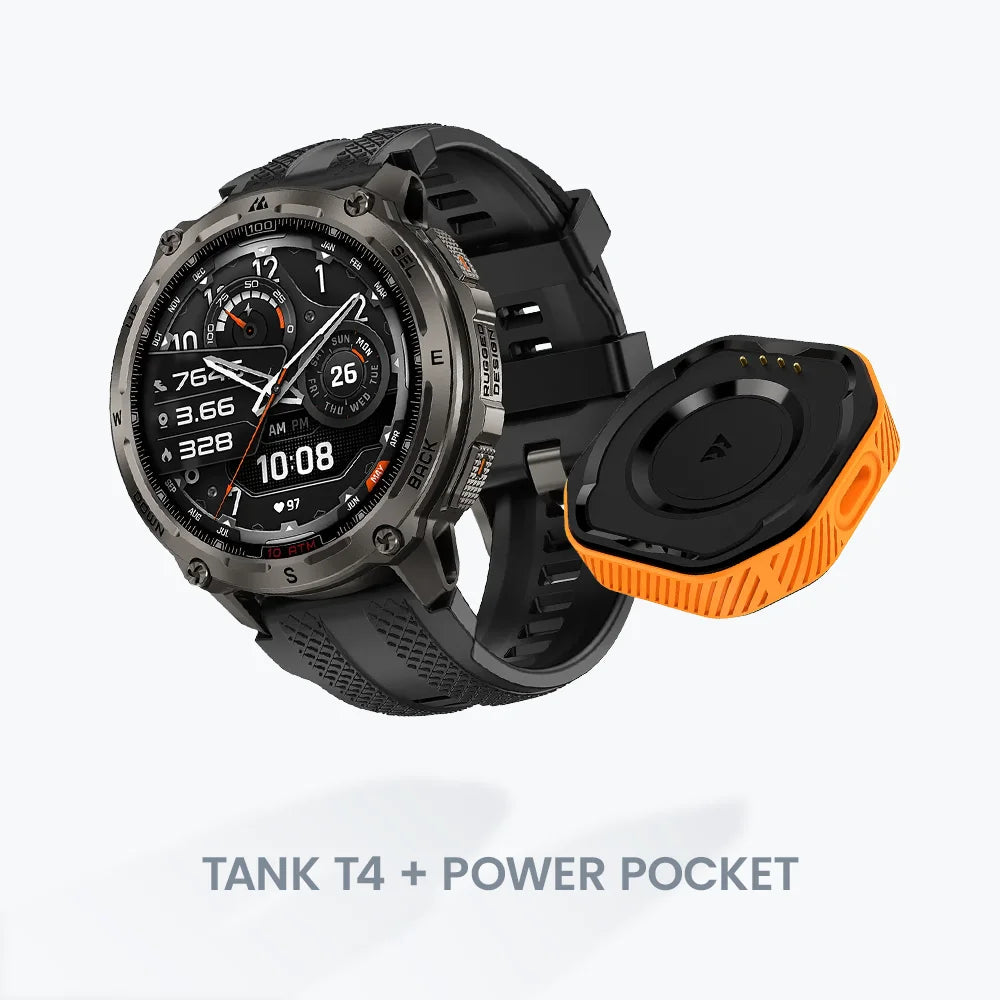
A great example of this reliability is the KOSPET TANK T4. This watch is built with a strong metal body to survive hits and drops in the mountains. It features physical buttons that are easy to press even if you are wearing thick gloves or if the screen is covered in rain.
The TANK T4 also provides very accurate GPS and supports clear offline maps. These features allow you to see your exact location and study the terrain around you without any phone signal. This makes it a dependable tool for hikers who need their navigation to work every single time.
Conclusion
Choosing a watch that offers both high accuracy GPS and clear offline maps is the best way to ensure a successful adventure. These two features are like a lock and a key. They belong together to keep you safe. GPS provides the data, and maps provide the context.
If you are just starting out, do not be afraid to learn how to use these tools. Start with small walks in a local park to see how the GPS tracks your path. Look at the maps on your watch and compare them to the ground you are standing on. This practice will build your confidence.
FAQs
Can I use offline maps on my watch if my phone is dead?
Yes. Offline maps are saved directly on the watch's memory. As long as your watch has battery power and a GPS signal, it will show your location on the map without needing your phone.
Does GPS still work in heavy rain or cloudy weather?
Yes, GPS satellites work in all weather conditions. While very thick clouds or deep canyons might slightly slow down the signal, your watch will still be able to find your location.
How much battery do offline maps use?
Using maps uses more battery than just tracking steps because the screen stays active. To save power, only check your map when you are at a trail junction or feel unsure of your direction.


Leave a comment
This site is protected by hCaptcha and the hCaptcha Privacy Policy and Terms of Service apply.